Sherwood Hughes
  • Home
  • Books
  • Short Stories
  • Blog
  • Forums
  • About
  • Contact

Posts by Sherwood Hughes

Winterizing Outside Plants

Sherwood Hughes

Posted on December 13, 2018

Exaco Trading Company Biostar 1000 Premium Insulated 8mm Twin-Wall with Protective Netting Cold-Frame from Amazon.com


As fall temperatures dipped in the Boston area to mid-teens at Thanksgiving, I was concerned that my original plan for winterization of my outdoor bonsai would not be sufficient. It seemed in retrospect that simple storage boxes were not going to be sufficient to protect my trees from Boston’s extreme temperatures. Boxes only provide protection from wind and I wanted protection against hard freezes. It felt like this would be another extremely cold winter, like the prior year.

Armed with this knowledge, I invested in a cold frame. Searching the web for an appropriately sized cold frame, I was lucky to find the Booster 1000, a premium insulated 8mm twin-wall constructed cold frame from Exaco Trading Company. You can find it on Amazon here. Be fore warned, it is not cheap at $216.86. It measures 40″ deep x 30″ wide x 17.5″/20.5″ height (the back is higher than the front). It was difficult to assemble, partially because the instructions are in German and all I could do was follow the pictures. I finally got it put together, but it took close to 2 hours. Frustrating but in the end satisfying that I had a decent system in place to protect the trees. I can also take this apart where each panel meets and store it easily in a storage unit. I will make my own instruction sheet and mark each side with a letter to guide putting it back together next year.

The top of the cold frame can be closed and has 2-panels that slide to provide easy access or air on a warmer day.


I moved the trees into two larger mulch insulated wood crates with stapled burlap on the sides so that air can circulate, and I put thick plastic sheeting on the bottoms of the crates with small holes for drainage. The crates where then placed in the cold frame. Additionally, I have a large plastic basket that resembles wicker. In this, I surround a few trees with mulch, and placed this in the cold frame too.

Trees buried in mulch, in crates or a large basket. The cold frame fit on top of these items


I only need to water them two or three times a week (at most) and this will slow down from January to March. I’m pleased with this setup and it’s easily storable when Spring arrives.

Categories: Bonsai

0 Comments

Fertilizing

Sherwood Hughes

Posted on November 12, 2018

Biogold Original fertilizer, available from Amazon.


I tested out a bunch of fertilizers this summer and settled on B.O Biogold Original. I’ll get to why in a bit. First, here are my impressions on the other fertilizers I tried.

Initially, I liked the idea of a liquid fertilizer but soon found it was not that efficient. I’m all about making it fast and easy, and using a liquid fertilizer, I found, required more steps than other methods. I had to replace one of my two existing watering sessions (morning and evening) with watering from a can. I never feel like watering from a can really soaks my bonsais well, and my collection seems to like alot of water. I water with a hose and a wand, and I get great results with this combination. Using liquid fertilizer in a watering can felt like I was moving backwards, not forwards. Secondly, measuring the amount of fertilizer and mixing it with the right amount of water always feels like guess-work. Thirdly, I found it difficult to find organic liquid fertilizers. Most of the ones I ordered from Japan were just chemicals, which, from my research, breaks down soil quicker than organics. I did find a liquid at my local bonsai nursery but again, it was a liquid. So I abandoned liquids altogether.

Next I tried rape seed cake. These are large biodegradable organic cakes that you just place on the top of your soil and as you water, they degrade and feed your tree simultaneously. I was partial to these because I felt like they broke down far too quickly. I also didn’t see any major difference in growth. And the bad part is that my dog liked them — anytime she was out on the patio and a bonsai was on the ground, she’s try to eat the cake off the top of the soil. I thought this might lead to an expensive vet bill. It also turned out that some birds where swooping down and eating it as well.

Next I tried small, 2 – 4 mm sized, pellets made of chicken poop and other organics. I liked the results I got but the entire patio stunk. If my neighbors spent more time on their patios, they would not have been happy. The dog liked to eat this too! Plus, it was hard to have guests over for rosé and cheese if the whole patio smelled of chicken poop. So that didn’t work well either.

Finally, I found B.O Biogold original. The pellet sizes are about 8 cm in width and they are placed on the surface of the soil, or buried relatively easily. Pellets last 4-6 weeks, which is much more efficient than fertilizing with liquid every two weeks. For shohin size trees, which most of my collection is, you only need a few on the surface. For really small mame size trees, you can easily cut a pellet in half and place each piece on opposite sides of the tree. I place them closest to the edge of the pot so that the fertilizer doesn’t harm any nebari near the trunk. For larger bonsai, you can place small baskets that have a stake on them around the pots edge and fill them with pellets. I also like how the pellets degrade. I like to change them every 4-6 weeks but I actually think they might last 8 weeks or more, even with an aggressive watering schedule like mine.

Categories: Bonsai

0 Comments

When You Have No Greenhouse

Sherwood Hughes

Posted on November 8, 2018

I will replace this crate with a larger one and a plastic sheet with slits in it will cover over the top in mid to late December.


There is a great way to protect your outdoor plants that I find works well. I did this during the 2017-2018 winter and am just starting to do it during the 2018-2019 winter. Here is what you need:

  • A large wooden slatted crate
  • Heavy clear plastic sheeting
  • Mulch
  • Burlap
  • Staple gun with staples

Staple the burlap to slatted outside of the crate. This will protect your plants from harsh winter winds but allow in enough air. Staple the plastic sheeting to the bottom of the crate and then make a few slits in it with a knife so that water can drain out. Put a layer of mulch into the crate, place your plants on top, and then surround each with a healthy amount of mulch. Do this in the beginning of November or before the first frost.

As December arrives and the temperature drops to freezing or below, I like to place more mulch into the crate to cover the entire pot as well as the lower portion of all of the trees’ trunks. Now, I staple a layer of thick plastic sheeting over the top of the crate and make slats in it to allow in water and air.

I left may plants outside throughout the entire winter of 2017-2018. In some instances I allowed snow to accumulate on the trees. And as soon as spring arrived, I removed them from the crate and disposed of the mulch. The crate then went into my storage unit for the next winter.

Categories: Bonsai

0 Comments

A Small Shimpaku Juniper

Sherwood Hughes

Posted on July 1, 2018

Before After

This project was a lot of fun.

Recently I’ve become enamored with small bonsai. “Shohin” (meaning “a small thing” in Japanese) or “Mame” (meaning “bean” in Japanese) are the classifications for small bonsai. The latter are 5 to 8 inches and the former 2 to 6 inches. Not surprisingly, their pots are smaller too, and with that additional reduction in pot size comes slightly different care needs, like more frequent watering and greater care when wiring.

In my opinion, shohin and mame bonsai are easier to care for in a city dwelling from the simple perspective that they take up less space. Thus, if you want a larger collection with variety, shohin or mame might be a good alternative for you. But sizes still require outdoor space of some kind. A small deck or back yard will do, preferably with direct sunlight. While direct sun isn’t desirable for all mame trees, you can easily craft a covering screen to provide shade or protection to those trees that can’t tolerate stronger sun (early spring and mid-summer).

So, with my latest interest in shohin and mame bonsai, I decided to re-pot a larger Shimpaku juniper that I bought last year. During the re-potting, I combined pruned both the top and the root system hard; experts say you should only do one per season but I threw caution to the wind. In the end I removed  90% of the top and almost 90% of the roots to fit a 1 1/2 inch (25.4 mm or 2.54 cm) cascade style unglazed pot. It’s only been two days since the re-potting, so it’s anyones guess if the tree will survive. Below are pictures. See what you think. Below the pictures is a brief description of how I turned this much larger tree into a tiny mame tree.

The tools I used were a root rake, a wooden chopstick, a concave branch cutter, a pair of find nosed tweezers, a wire cutter, two different widths of wire, and a pair long scissors like trimmers.

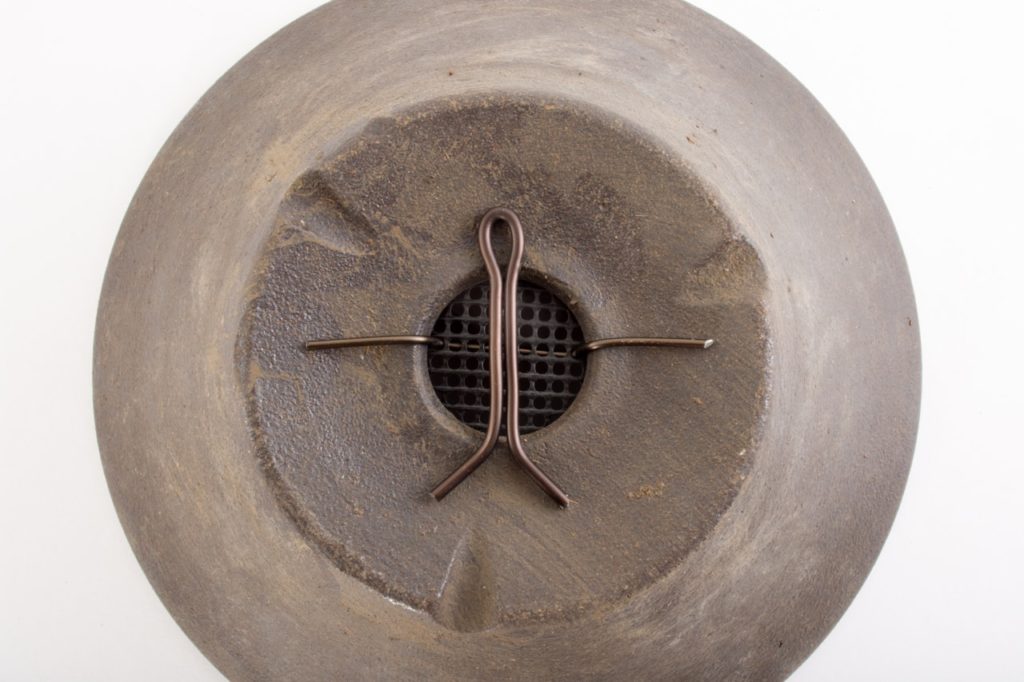
To start, I cut off the wire holding the Shimpaku in its original pot. Then I slid the tree out and using the rake and chopstick removed all of the old soil. Then I cleaned the roots with water and prepared to trim back the main branch. I left 4 sets of two branches each on the main trunk.  Then I removed the first two sets closest to the root ball. This left 2 set of branches on each side. I cleaned these up by removing a few needles from the under side and where each branch meets the main trunk. A few twists to remove brown branch ends completed the pruning. Next, I wired in the mesh screen, added a wire for securing the bonsai, and a light layer of small pebbles on the bottom. A small layer of all-purpose bonsai soil from Bonsai West in Littleton, Massachusetts followed. The tree was then wired in. This is always the most difficult part for me. I’m not sure why but I’ve not got the knack for securing a tree with a single wire, but after some trial and error, to my surprise the tree was secure. I then added more soil and worked it with my chopstick making sure the soil well positioned amongst the roots. I left a small lip gap at the top where I placed cut up rehydrated sphagnum moss. Then I used a double-strand of wire to bend the trunk of the tree more profoundly then it had been in it’s prior pot.

And the wire helped to turn the branch area up at the end. I think I might need thicker wire at the end because I want a more pronounced shape. Maybe at the end of the summer.

For more information about shohin bonsai, read this post at Bonsai Empire, or this post about mame bonsai. Also, Shohin-Bonsai Europe is a great resources for information about smaller trees.

Categories: Bonsai

0 Comments

Repotting

Sherwood Hughes

Posted on May 27, 2018

Repotting wiring example High-res version

One of the things that most vexes me when repotting is how best to secure the tree. I’ve found ways of doing it but I was never that happy with my results. Either the wire twisted around the wrong way or the tree just wasn’t firmly seated in the pot. I recently found a very good blog post on bonsaitonight.com that covers multiple ways of securing a tree to the pot. I wish I’d found this post eons ago because it would have saved me tons of frustration!

Read the post here.

Enjoy!

Categories: Bonsai

0 Comments

Protecting Small Bonsai from Harsh Weather

Sherwood Hughes

Posted on May 25, 2018

Large Pot High-res version

I recently had both a mame Shimpaku juniper and a shohin Tropical Cherry topple due to high winds. There was no pot or plant damage to the Shimpaku. However, the Tropical Cherry was completely uprooted from its pot (I was planning to repot it anyway and had not secured it to the temporary pot). I swiftly repotted it, securing it to the pot with wire.

This got me thinking about methods for protecting smaller bonsai from sudden gusts of wind and other storms. I found quite a bit of information online so I thought I’d digest most of it here.

For shohin bonsai, there are two ways to protect them from the elements. The first is a common way by using string. The second is a method I found partially on the internet with my own modifications.

The first or string method secures the tree pot the plank it sits on using string (this assumes the tree is on a plant or table that you can tie string under and above). Do this by tying two pieces of string across each side of the pot with the tree stem between the two strands and tying the string in knots under or at the edge of the table/plank. You can also use one piece of string and criss cross it under the table to cross both sides on top. These are pretty common and you can find a number of articles that show different ways of implementing this method as well as the types of knots to use.

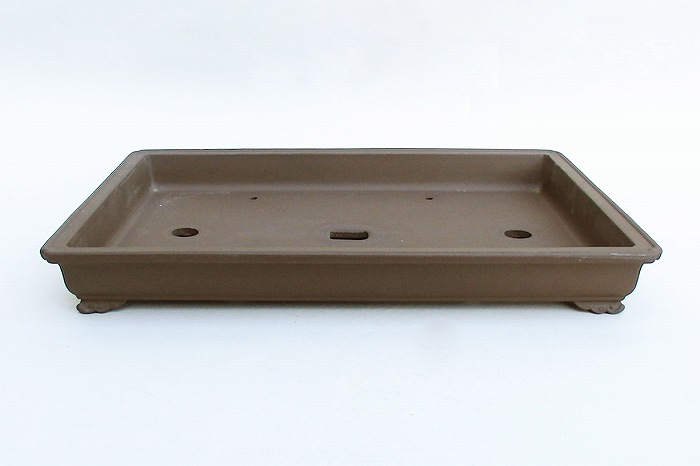
The second method is appropriate for small shohin or mame trees. First, you need to find a large bonsai pot or a larger tray that has drainage holes. This sounds easier than it is and it will undoubtedly be more expensive than the string method, but I think the will looks better, retaining a zen quality to the display. (See the image for an example of the type of pot I’m referring to).

The pot is large, over 20″ wide and about 13″ deep with a height of almost 4″. Prepare the pot with screens, then fill the bottom with larger pea sized gravel. On top of that use a good blend of 2mm-3mm Japanese bonsai soil (Akadma & pumic) and mix in a small amount of peat moss and crumbled bark mulch. The bonsai soil will provide good drainage and the peat moss and crumbled bark will help to retain some moisture. Fill the pot with this mixture leaving 3/4″ of before the rim. Now fill in only Japanese bonsai soil on the top leaving about a 1/4″ – 1/2″ lip. Now water the soil well until water seeps through the drainage holes. This will help to eliminate dust in the Akadama and pumic mixture and will moisten it well. Now, place your smaller trees into the pot by sinking them into the soil mixture by a 1/4 of an inch. You can sink them to a greater depth if they are more prone to tipping.

Not all trees can be sunk and secured this way. For example, cascading trees need to be sunk in the corners or up against a side so that the tree can cascade over the side of the larger pot but this isn’t going to work for every cascading tree.

I implemented this on my deck recently and found it was an effective way of securing my small trees and it has the added benefit of looking nice with my existing patio furniture thereby retaining a look that I was striving for.

Good luck and let me know if you have found other ways of securing your bonsai against the elements!

Categories: Bonsai

0 Comments

An Obsession Part III

Sherwood Hughes

Posted on June 3, 2015

Midori Traveler's Notebook Blue Edition

Midori Traveler’s Notebook Blue Edition

As I’ve searched the internet the past few weeks for different types of journals, I’ve stumbled across the Midori Traveler’s Notebook by Midori from Japan. Let me just say that my debit card has sadly been the target of this journal and its many accessories. Having said that, the Midori Traveler’s Notebook is eminently affordable and you can customize it to your heart’s content. There is also a thriving community of folks that post videos on YouTube their Midori Traveler’s Notebook “un-boxing,” how they use their notebook, and how they choose to organize the contents. My favorite video is from Stuff and Things (https://youtu.be/tBRjYNQ1qio), primarily because, as he says in his video, his review won’t be like the many videos already on YouTube by “artsy crafty women with long painted nails and lots of dangling jewelry” (be steady my heart), who talk in “great detail about how they had set up” their notebook with oodles of scrap booky handmade inserts etc. As sexist as his statement may be, he’s right, and that’s what I find so funny. So on with my review.

Midori Traveler's Notebook Star Ferry Edition

Midori Traveler’s Notebook Star Ferry Edition

The Midori Traveler’s Notebook is a leather cover that can contain any number of inserts. The inserts can be notebooks, Kraft file folders, plastic zip pouches, card files, sketch books, and more. The covers come in two sizes, standard and passport. The standard size is approximately 5.1″ wide X 8.4″ tall. The passport size is 4.6″ wide X 6.1″ tall. The passport size can evidently hold a passport while traveling, which for some, will make it an excellent choice for capturing thoughts about their travels. The leather covers come in two standard colors, black and brown, but every now and then, Midori comes out with special editions. Two such editions are: a 2013 Hong Kong Star Ferry Company special edition with a tan leather cover in passport size, and a 2015 Pan Am special edition with a medium blue leather cover in standard size. Both of these special editions came with a number of fun, and at times, silly, accessories. For the record, most of the accessories for the 2013 Hong Kong Star Ferry edition are now out of stock, and despite many attempts, I was unable to find the leather cover. Special pencils, pens and holders, fun stickers, and other stuff will take up hours of your time and make you think you are going crazy. Trust me I speak from experience.

The notebooks you can insert come in blank, lined, and graph paper. Some notebooks have thinner paper and more pages, some are made of Kraft paper, which seems like it is good for folks that want to sketch, and some of the notebook’s pages are scored for easy removal. There are monthly and weekly diaries available as well. Most of the videos I’ve watched on YouTube claim not to use the notebook as a calendar but as a writer’s or traveler’s journal. This seems to make sense to me in this day and age of smart phones. Most of these inserts are available on Amazon, but another brand, Banditapple, is available at Goulet Pens website.

Despite my making fun of some of the accessories, there is something decidedly fun about these notebooks. They are not high style but rather have a homemade feel. The simple leather cover is just a large rectangle of leather that folds over to protect the contents. They have a vertical elastic in the spine that for holds the inserts and an elastic around the middle to keep it closed. You can use additional elastic bands (an accessory), to load in more notebooks by piggy-backing off of a primary insert. There are other ways of loading in notebooks, which you can research on YouTube. Some folks have even gone as far as to punch additional holes in the spine and string more vertical elastic into the cover to avoid the piggy-backing of inserts. You can even remove the closure elastic and add charms to it, and to the end of the built-in bookmark. Customizing it is what makes this notebook fun and it reminds me of all the keychain types of charms my nieces used to hand on the zippers of their knapsacks years ago.

This notebook is fun, relatively inexpensive if you can control your desire to get all the accessories, and useful as well.  I bought a regular black, and change the horizontal elastic with a red elastic. I also bought the Pan Am special edition, and a black passport size. I’ve filled them all with fun inserts, and coins with holes in them as charms on the middle closure elastic. I’ll use the passport size for a planned trip to Brugge, Belgium and Amsterdam in the fall. The sheer number of accessories and knock offs (search “faux midair” on Etsy), I think is testament to how successful this notebook has been. So run out and get one yourself, but don’t blame me if you can’t control your urge to accessorize!

Categories: Writing

0 Comments

An Obsession Part II

Sherwood Hughes

Posted on May 29, 2015

Levenger's Stanley Journal High-res version

So yesterday I shared with you my new obsession, journals and pens, and in specific, I reviewed the Allen’s Journal.  Nothing has changed today; I’m still obsessed. I think this will go on for a bit so sit back and enjoy the review of the next journal.

20 year old black leather Levenger Stanley Journal Cover

20-year-old leather Levenger Stanley Journal

The journal I looked at for part II is Levenger’s Stanley Journal. I’ve had this smooth leather journal cover for almost twenty years. Last year, however, when I went through a pebble leather obsession (yes, I know, I need to control my impulses), I purchased from Levenger a new black pebble leather cover. There was simply no comparison between the old and new covers. The twenty year old cover is incredibly well made, and looked like it was an expensive leather piece when I bought it. It still looks fantastic despite tons of use. The 2014 cover by contract, is slightly larger, isn’t nearly as well made, and feels flimsy right out of the box. The workmanship is similar to most of Levenger’s other current leather goods: cheaply made. This cover just isn’t up to the standards Levenger had years ago, which from my perspective is really unfortunate. For example: the stiff boarding in the front and back cover visibly ends near the binding area of the cover — you can see and feel the outline where the stiff boarding under the leather ends. It is incredibly unattractive. The current cover measures 6 1/8″ X 8 1/2″ and you can personalize it with your initials. You can find it on Levenger’s website, although with what I’ve shared here, I don’t know why anybody would consider buying it unless they simply didn’t know anybetter. Thank God I kept 20 year cover, because it still looks great.

The one thing going for the Stanley Journal is that it is refillable, something that is lacking in most good journals. The refills come in sets of 2 notebooks, 118 lined pages with gilt edges, and a linen brown cover that inserts into the leather cover. I received two of the earlier line blue covers before Levenger changed the color to Brown — so keep in mind I am reviewing the blue linen cover refills here. They are 5 1/2″ X 7 3/4, and fit well into the older leather cover, and a tad loosely, from my perspective, into the new cover. I was really exited to get these because it meant I’d be able to keep using a cover I really like, but the paper turned out to be a disaster.

If you are a fountain pen user, the paper in these refills will drive you batty. I used three pens when I did a writing test: a 1956 Sterling Silver with gold nib fine Parker, a Lamy CP1 with extra fine nib, and a TWSBI 580 Diamond Clear with an extra fine nib. In each case, my writing samples experienced feathering. And when I turned the page to continue writing on the other side there was enough bleed through to make further writing impossible. Note: using these same pens and the same writing tests on an Allen’s Journal yielded no feathering and no blade through. but when I turned the page to continue writing on the other side there was more than enough bleed through.

What a huge disappointment. So now starts my search for notebooks that will fit my lovely 20-year-old leather cover (I threw out the cheaply made 2014 pebble leather one).

Stay tuned for part III. I’ll be writing about the Japanese Midori Traveler’s Notebook.

Categories: Writing

Tagged: Writing

0 Comments

An Obsession Part I

Sherwood Hughes

Posted on May 28, 2015

Rarely do I get so obsessed with something that I wonder if I’m loosing my marbles, but that’s exactly what’s been happening for the past two weeks. My obsession started because I had ankle and foot surgery about four and half weeks ago, and as part of recovery, I must remain home from work, with my foot in a surgical splint, elevated above my heart for as many hours a day as I can stomach. Seems easy right? Not so fast buckeroo. It’s as boring as hell. And with boredom, you guessed it, came obsession.

What obsession you ask? I’ve finally indulged my love of journals and pens, and done so for more than a week. So I must be obsessed, right? I already had two fountain pens, one an antique Parker and the other a Lamy CP1 with an extra fine point, but I’d never been able to maintain a journal for more than a few days. I’d start, and then stop, which is pretty typical from what I’ve read on the internet. But now, I’m whole hog into it. I’m writing two pages daily, by hand no less, on thoughts about life, my job, frustrations with life, my ankle and foot that continue to throb, and anything that comes to mind, including ideas for short stories, and an itinerary for an eleven day trip to Bruges and Amsterdam in the fall. Hum, hopefully I’ll be able to walk decently because it involves a ton of walking.

The two journals I’ve been using are an Allen’s journal by a Scotish bible printer (not a religious thing) and a Levenger’s Stanley journal.

The Allen’s journal is by far my favorite of the two journals. I love the 4mm thin ruled paper, which is red under gold edging, and extremely well bound with a built-in bookmark. I’ve never found a journal that was less than 6mm ruled, so this was a real find. The newer versions have a gray line instead and the rule has been increased to 5mm, but it remains a great option for those who like ultra thin ruled paper and whose writing or script is small. The paper is incredibly thin, which I like. Despite that, your will not experience feathering or bleed through when writing with a fountain pen in this journal, a real testament to the production quality of the paper and the product overall. There are 256 pages in this and because the paper is so thin, the book is just under a half inch thick. Mine has a black goatskin leather, which is very supple. Some of their journals use other types of leather like calfskin, but they are just as beautiful. Allen’s journals come in other colors as well, like red, green, brown and tan. My cover has “Journal” printed in gold leaf lettering. Note: newer versions of these journals omit the cover gold leafing and the paper is slightly heaver. I prefer the older style, but I’m ultimately fine with these changes. The journal comes in two sizes:  6 1/8″ X 4 1/2″, a passport size, and a larger 8 3/16″ X 5 3/8″. The smaller size is, as of this writing, £30.00. The large is not currently in stock so I can’t quote you a price. Allen’s ships to the United States as well. I love this journal. In fact I love it so much I’ve been known to kiss the cover. Yeah, I know, weird, but true.

If you are looking for a good journal, try out Allen’s in England at https://www.bibles-direct.co.uk and click on the “Journals” item in the page navigation on the left. While they are a bible printer you won’t get strange emails trying to sell you bibles. The one draw back so far with this journal is that they print them at the same time they print up new batches of bibles. As a result, they’ve been out of the larger size for about six months. I’m hoping, and I check back often, that they print some up soon.

Enjoy!

Categories: Writing

Tagged: Journals

0 Comments

A Writing Class Experience

Sherwood Hughes

Posted on September 22, 2014

In the first half of 2014 I decided to take a creative writing class. The class was in Cambridge Massachusetts and funnily enough, taught by a neighbor that lives a few blocks from me in the South End of Boston. I was later to discover that we also have at least one friend in common – yes, Boston is small. So I dutifully signed up, paid my fee, and got myself psyched for “going back to school.” I actually like school, so that wasn’t a huge stretch. I also figured, if anything, it would help me with the seven chapters of a murder mystery I’d already spent a number of months researching, taking notes for, and writing. Yes, you guessed it, I work slowly at…

Categories: Writing

Tagged: Writing

4 Comments

+Read more


Categories

  • Bonsai
  • Writing

Archives

  • December 2018
  • November 2018
  • July 2018
  • May 2018
  • June 2015
  • May 2015
  • September 2014

Return to top

© 2018 Sherwood Hughes. All Rights Reserved.

Loading Comments...